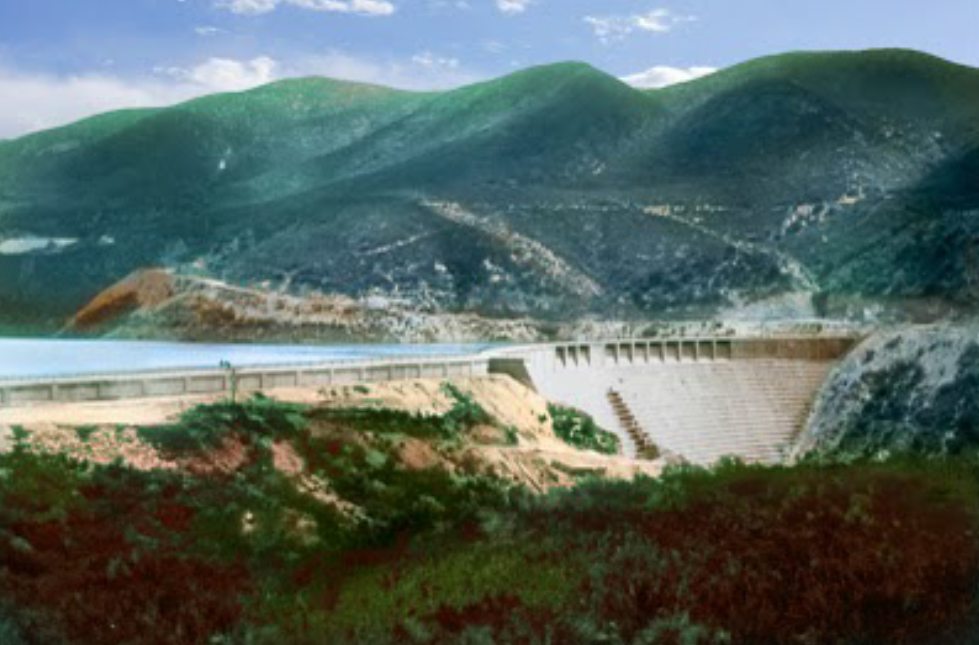
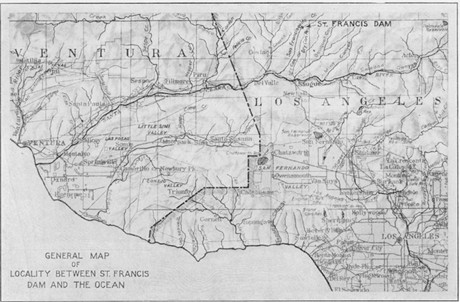
The St. Francis Dam breached just before midnight on March 12th, 1928, killing roughly 425 victims. It remains the second deadliest dam failure in American history, behind only the South Fork Dam breach that led to the Johnstown Flood of 1889. The St. Francis saga began in the early 1900s as the population of Los Angeles boomed. In response, the city’s chief water supply engineer, William Mulholland, designed and oversaw construction of the Los Angeles Aqueduct to provide the city with adequate drinking water. The system spanned hundreds of miles across California, and Mulholland was justly hailed as a miracle worker when it opened in 1913. However, Los Angeles continued growing explosively, and as the Roaring Twenties began, Mulholland was called upon again to expand the city’s water supply. He selected a site in the San Francisquito Canyon about 35 miles northwest of the city’s downtown for a reservoir and chose to impound it using a concrete gravity dam [2, 7].
By the early 1920s, William Mulholland had over four decades of civil engineering experience. He was self-taught, as was then common among California civil engineers, and had previously supervised the design and construction of several dams which remain in service. However, he was also notorious for keeping his own counsel and had primarily designed embankment dams, not concrete ones. The Golden State had passed a civil engineering licensure law in 1917, but it exempted municipal engineers such as Mulholland from external oversight, meaning no one had the authority to review his work on the St. Francis Dam. Thus, his design wound up far short of the contemporary standard of care for dam engineering. The 1923 book Foundations, abutments, and footings, a widely available text, included a section on the engineering of dam foundations by seasoned dam engineer Charles Paul, which provides insights on the era’s best practices [2, 3].
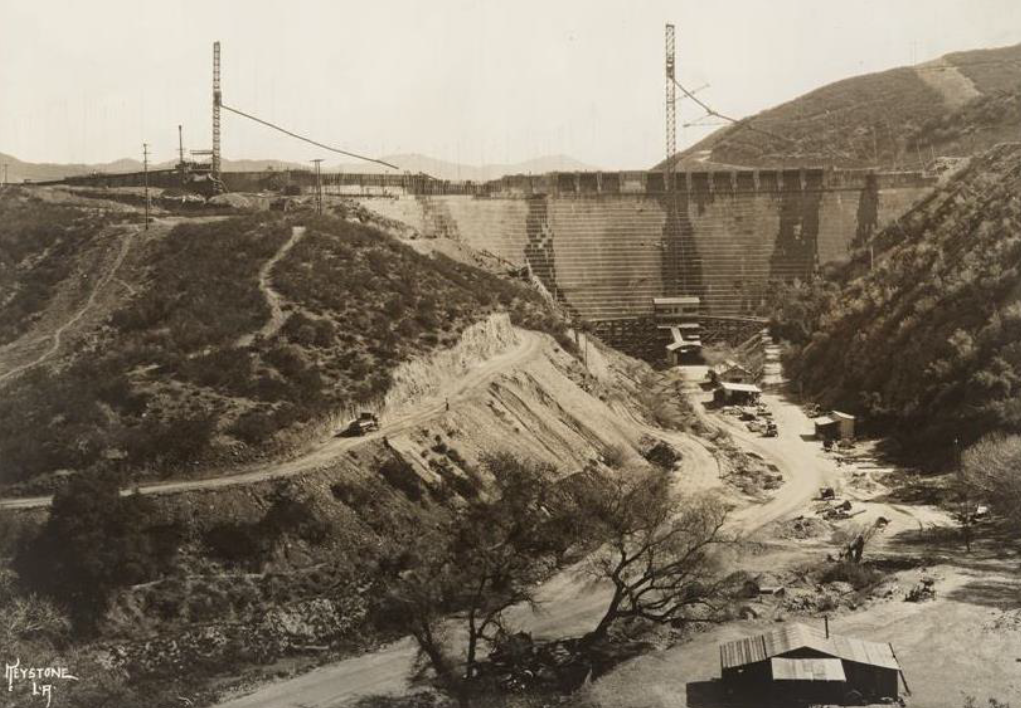
Paul noted that dam foundation design needed to cover factors such as “bearing power, water tightness or control of seepage [,] prevention or control of upward pressure, prevention of sliding of the dam on its foundation or of the foundation itself, and protection against scour below the downstream toe or apron.” He elaborated that these considerations were crucial since “failure to understand foundation conditions, or to appreciate their importance, has often resulted in disaster.” Paul then discussed foundation requirements for masonry or concrete dams over 200 feet tall; the St. Francis Dam topped out at 205 feet high. He stated that “firm, hard rock, without open seams, fissures, or faulting,” was “the only suitable foundation” to ensure adequate bearing capacity, seepage control, and uplift prevention beneath these structures. The San Francisquito Canyon site hardly met this definition, as the planned dam’s east abutment was underlain by a fragile, fissile mica schist formation and its west abutment overlay a friable sandstone formation [2, 3].

Charles Paul appreciated that not every reservoir site would provide ideal subsurface conditions for a dam. Accordingly, he wrote, “it is desirable to have a careful geological examination of the foundation conditions,” ideally involving “an investigation and report by an expert practical geologist” assessing the bedrock’s “probability of fissures and faulting, [and] former upheavals and disturbance.” Such a study at the St. Francis Dam site would likely have uncovered the sandstone’s and mica schist’s susceptibility to seepage, along with a sizable paleo-landslide looming above the proposed dam’s east abutment. However, Mulholland neglected to consider the site’s engineering geology at length as he began designing the dam. He and a Stanford geology professor briefly visited the canyon before starting design, but such a trip was hardly a proper geologic study. The oversight was particularly egregious because workers building the Los Angeles Aqueduct nearby a decade earlier, under Mulholland’s supervision, had complained of the mica schist’s hazardous dip and tendency to expand upon excavation [3, 4].
Paul also recognized that no geologic study could fully describe subsurface conditions at a potential dam site. Therefore, he noted, “subsurface examinations become increasingly important as the character of the material is less reliable.” He recommended using both soil samples from wash borings and test pits. Furthermore, Paul stated that rock corings extending at least 20 feet were necessary to verify where bedrock lay beneath the site and to assess its quality and potential faulting. Unfortunately, William Mulholland’s site investigation for the St. Francis Dam deviated sharply from Paul’s recommendations. His crews dug no test pits and drilled only 4 or 5 borings, all at the dam’s west abutment, which they terminated just 14 to 16 feet below existing grade. The crews also performed a crude falling-head permeability test in one of these borings to gauge the sandstone’s permeability [2, 3].
Mulholland’s laborers performed further site exploration at the St. Francis Dam’s east abutment, but their technique of choice likely did far more harm than good. After the breach, multiple workers testified to a coroner’s jury that they had excavated, partially via blasting, a tunnel into the mica schist about 30 feet long and “big enough for a man to work running a wheelbarrow” to assess its quality. They did not backfill this excavation with concrete until dam construction had begun. Excavating a sizable tunnel into this formation using uncontrolled explosives and then leaving it open for a while almost surely harmed the geological stability of the site and dam. This was especially true given the mica schist’s tendency to expand upon atmospheric exposure, which led the workers to call it “heavy ground” [2].

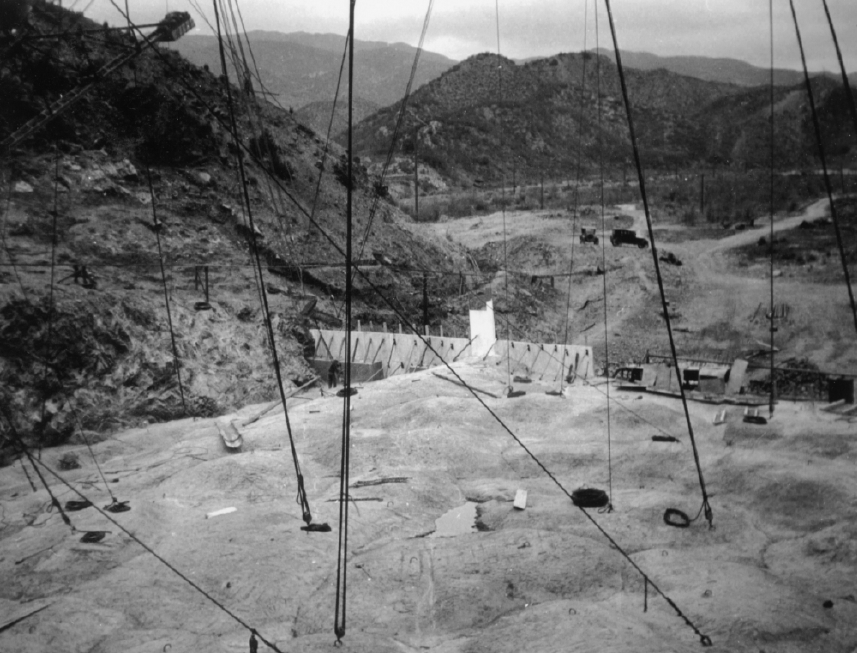
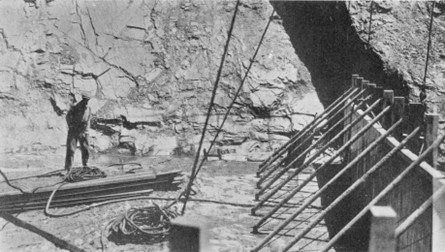
Charles Paul also offered guidance on properly excavating bedrock for a dam foundation. He wrote that “all loose or soft rock should be carefully cleaned off and removed.” Paul quickly stipulated that rock susceptible to decomposition upon exposure should first be excavated only to within a few inches of the dam foundation’s intended limits and that the remaining material could be removed just before concrete placement. However, the crews at the St. Francis Dam did not follow this guidance. In addition to the ill-considered mica schist tunnel, construction photographs show work on the dam’s foundation proceeding without proper clearing of talus and loose rock from the hillsides before pouring concrete [2, 3].
Paul next covered the mitigation of uplift and seepage beneath dams using subsurface grouting, cutoff trenches, and/or uplift wells. “Prevention or control of upward pressure in masonry dams is a subject which has been under lively discussion for many years,” he wrote, and “is not difficult usually.” Civil engineers had by 1923 been warning about uplift for over a decade, since the uplift-induced Austin Dam (also known as Bayless Dam) breach had killed 78 people in Pennsylvania in 1911. “It is a crime to design a dam without considering upward pressure,” one prominent US civil engineer declared following the Austin breach. Civil engineers were still disputing how best to compute it as of 1923, but as Paul wrote, “all are agreed that it must not be disregarded and should reasonably be provided for.” Unfortunately, William Mulholland did not share in this consensus [2, 3].
Charles Paul first discussed grouting for dam foundations on rock, noting that doing so was “standard practice in the construction of high masonry” and concrete dams. He had already successfully grouted foundations for several major US dams, including Arrowrock Dam in Idaho and Lockington Dam in Ohio. Paul understood that per Darcy’s Law, well-established by 1923, creating a grout curtain beneath a dam lengthened the flow path, l, of water under the structure, thereby decreasing the hydraulic gradient, i, and thus the total seepage below it. Yet Mulholland incorporated no program of foundation grouting into the St. Francis Dam despite the known expansion issues in the “heavy ground” mica schist. In fact, no evidence has emerged that he and his team even considered utilizing such a program there [2, 3].
Paul then turned to the engineering of cutoff trenches for controlling seepage and uplift below dams. He explained that these were usually excavated “across the foundation along the heel or upstream face of the dam.” Paul stated that such trenches “should be at least 3 or 4 ft. deep in any case, and should be continued up the abutments, and along the full length of the dam.” For dams on softer rock, he added, “deep cut-offs or curtain walls of concrete are also desirable at both upstream and downstream faces of the dam.” Once again, William Mulholland missed the mark on this count in his design for the St. Francis Dam. Another civil engineer who visited the site during construction observed “no indication of trenching up the hillsides to provide vertical abutment faces.” The situation was even worse in the dam’s center, where the upstream portion of the foundation did not reach bedrock and was excavated 8 feet shallower than the remainder. Mulholland and his lieutenants could scarcely have made a less considered decision in this regard [2, 3, 4].
Finally, Charles Paul covered the engineering of uplift wells for dam foundations. For large dams, he explained, it was usually “feasible to construct drainage galleries lengthwise of the dam [and] close to the upstream face.” Within these, wells could be drilled “to provide relief for any upward [hydrodynamic] pressure which may exist.” Paul had used uplift wells at the Arrowrock Dam, as had engineers at other prominent US dams of the era. Unfortunately, William Mulholland and the St. Francis Dam team came up short in this regard as well. He recognized the need for some uplift protection at St. Francis and did include 10 wells 2 inches in diameter beneath the central 120 feet of the dam. Since the structure was 661 feet long, though, this decision left 270 feet of the structure on either side – i.e., both abutments – unprotected by such wells [2, 3].
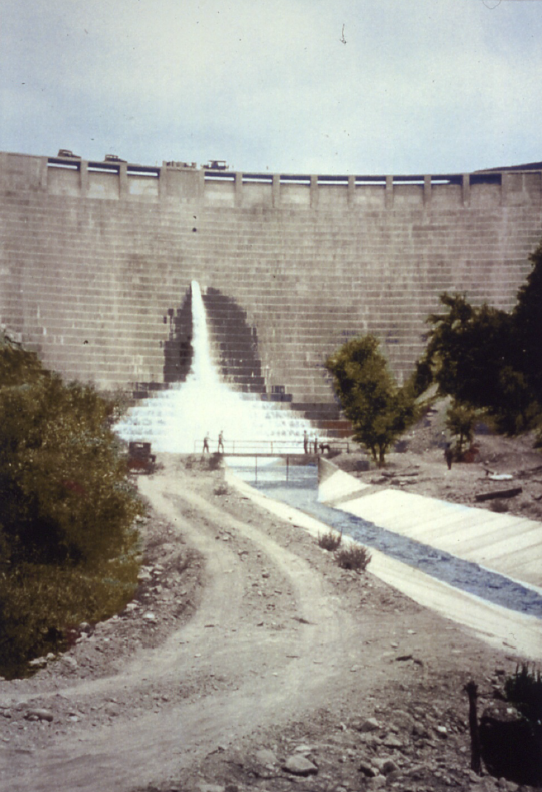
The problems at St. Francis Dam only intensified as construction began in 1925. While Mulholland opted to raise the structure from 185 feet to 205 feet high midway through the project, he never widened its base proportionately, leaving it vulnerable to sliding, overturning, and uplift. His crews used underweight (141 pounds per cubic foot), unreinforced concrete to build the structure, further lowering its already perilously low factors of safety against uplift and sliding. Yet all seemed well in the spring of 1926, when the St. Francis Reservoir was opened and filled to a relatively conservative 55 feet below the dam’s crest. A storm the following spring brought the reservoir to within 3 feet of the crest but created no immediate cause for alarm. Still, temperature cracks in the structure’s concrete were a running issue. While these did not directly contribute to the breach, Mulholland’s failure to account for this issue in his design reflected his broader lapses in engineering judgment on the project [2, 6].
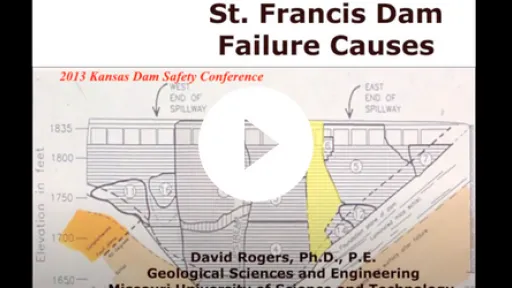
Heavy rains throughout early 1928 raised the St. Francis Reservoir to within first a few feet, and then only a couple inches, below the dam’s crest. As the reservoir sat full for weeks, permeation through the fissile mica schist beneath the east abutment and the dam increased per Darcy’s Law. Locals, including St. Francis Dam’s keeper, soon noticed increasingly severe leaks at the dam’s groins. On the morning of March 12th, he telephoned Mulholland with his concerns. Mulholland and his deputy engineer promptly headed out to the St. Francis Dam, which they toured for about 90 minutes. The engineers noted the multiple leaks at the east abutment that had caught the dam keeper’s eye, as well as more apparent ones at the west abutment. Mulholland told him to monitor the situation and keep in touch, but neither he nor his deputy felt particularly concerned. At around 8 PM, though, water level readings taken atop the dam began indicating a perceptible dropping of the reservoir. Eyewitnesses recalled no signs of increasingly severe leakage causing such a drop, and the reality was even more terrifying. The uplift forces from the growing seepage through the mica schist were increasing and slowly popping the dam up from the canyon floor [2, 4, 6].
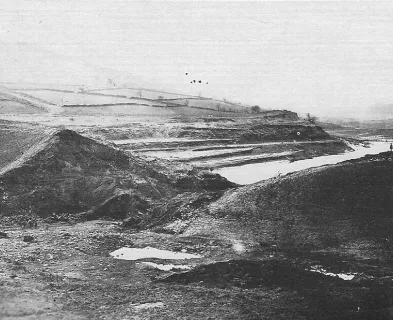
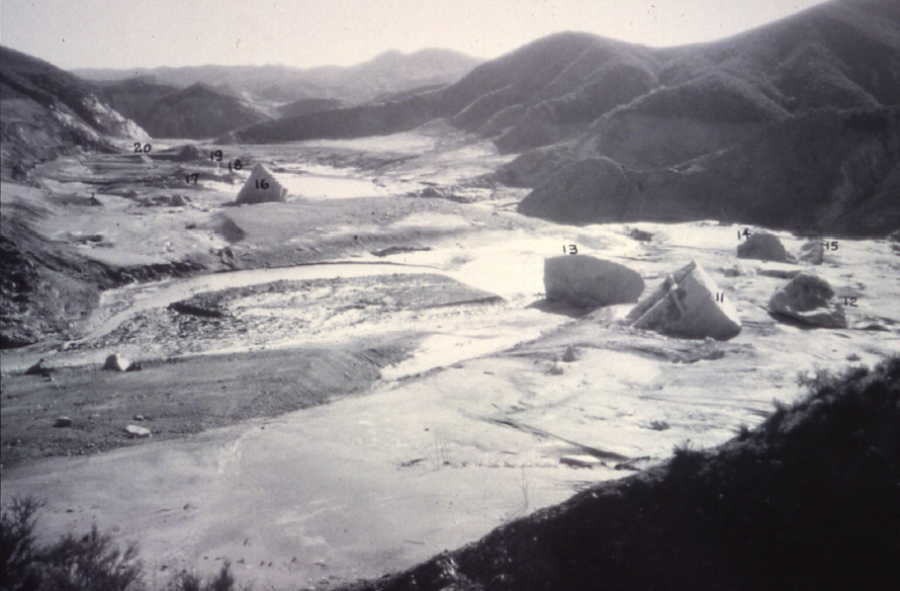
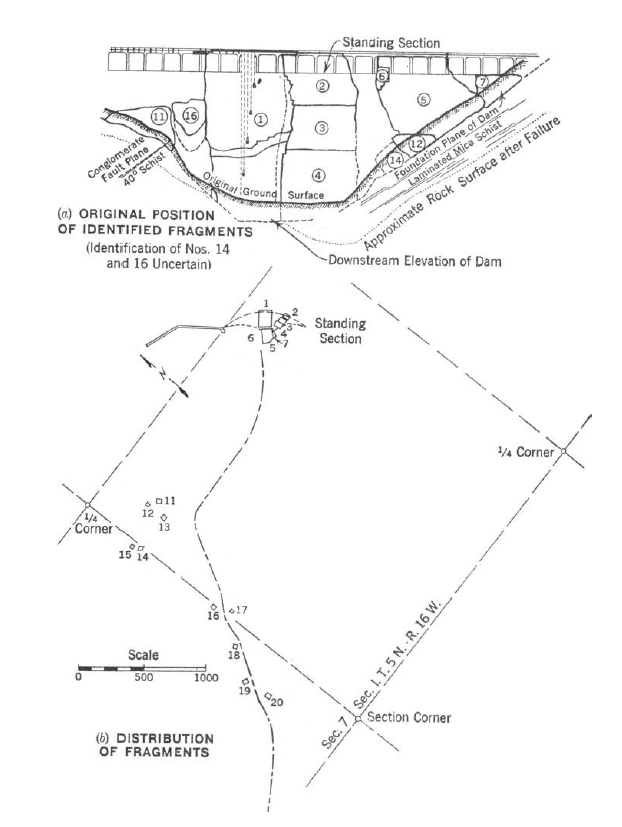
By roughly 11:55 PM, the increasing permeation through the mica schist was reducing the St. Francis Dam’s factors of safety against sliding and uplift to perilous levels. Eventually, these compounding problems broke off a significant piece of the dam’s east abutment, labeled “Block 35” by investigators. This created a nozzle through which water cascaded from the reservoir. This outflow, together with the seepage through the mica schist, reactivated the paleo-landslide above the east abutment. The entire abutment gave way at 11:57 PM, as captured by the failure of a power line adjacent to the dam. This failure in turn removed the final check on the paleo-landslide, which broke loose in full force and left a trail of mica schist fragments through the San Francisquito Valley [2, 4].
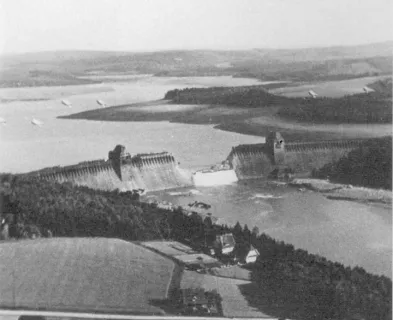
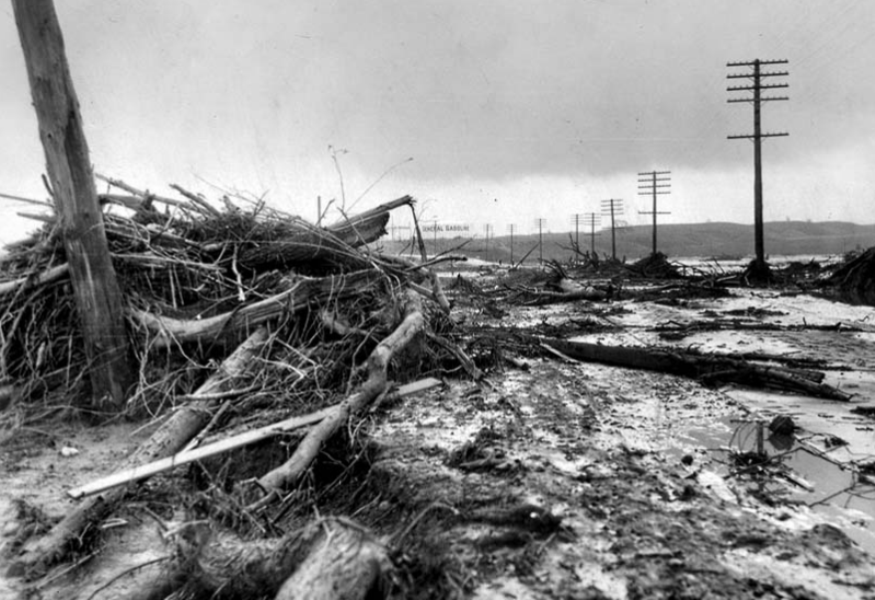
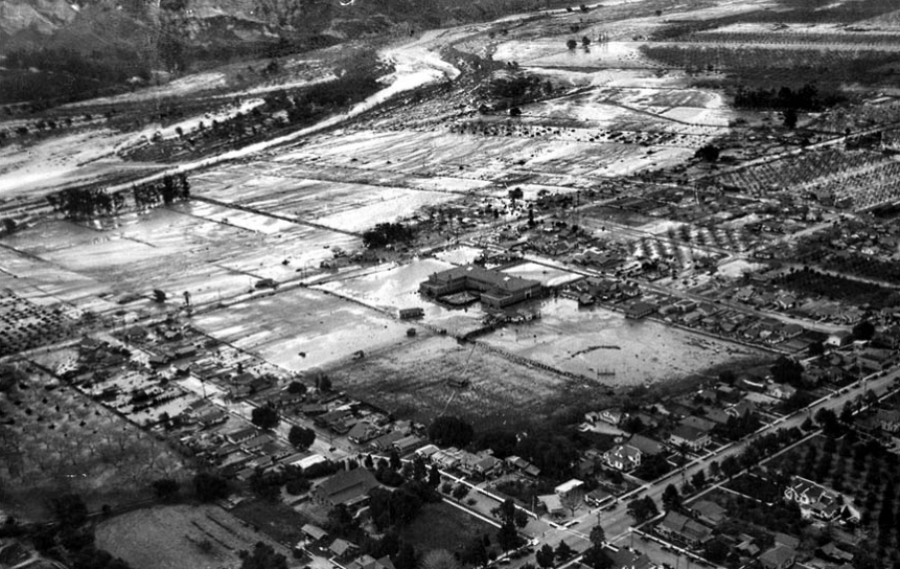
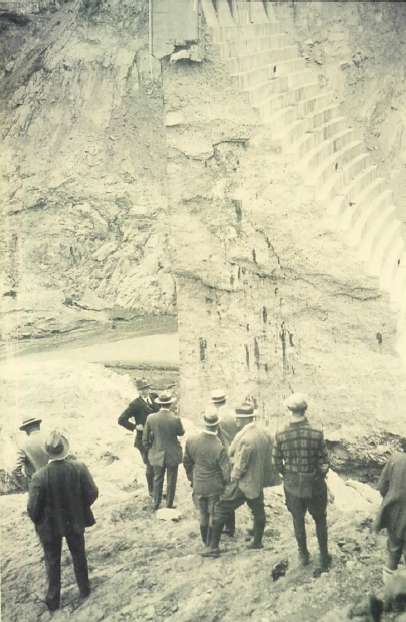
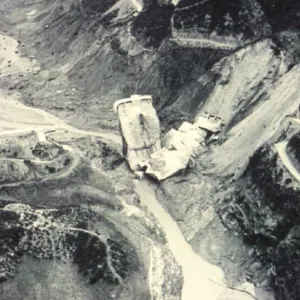
As the St. Francis Reservoir surged through the final breach, it wrenched the dam’s center away from its west abutment. The reservoir had fallen at least 40 feet by the time the crack between these two sections grew wide enough that the roaring waters poured through it. The west abutment then also gave way, though the delay considerably reduced the damage along the valley’s west side. By the time the reservoir emptied, 12.5 billion gallons of water had inundated the valley below. All that remained at the dam site the next morning was its center, which loomed grimly over the scene. The mammoth crack in its base showed how close it had also come to being toppled by the flood that had killed over 400 citizens, including the St. Francis Dam’s keeper. Large-scale emergency warning procedures still lay in the future as of 1928, but strenuous local efforts in the early hours of March 13 saved hundreds of lives downstream of the dam. Switchboard operators made scores of timely telephone calls, and law enforcement officers sped between towns giving door-to-door warnings of the onrushing danger [2, 4, 7]

Expert panels and independent engineers and geologists began investigating the St. Francis breach within days and published their findings before year’s end. The Governor’s Commission, the blue-ribbon panel investigating the St. Francis breach, submitted its report within a month. Its members had more than purely technical considerations in mind. California’s delegation in Washington, DC was working at the time to steer the Boulder (now Hoover) Dam through Congress, as would happen in late December, and the failure of an extant concrete gravity dam in the Golden State threatened the new structure’s prospects. The Governor’s Commission therefore reported that the dam’s surviving center section demonstrated the strength of concrete gravity dams, skating past the evidence that it, too, had nearly failed [2, 6].
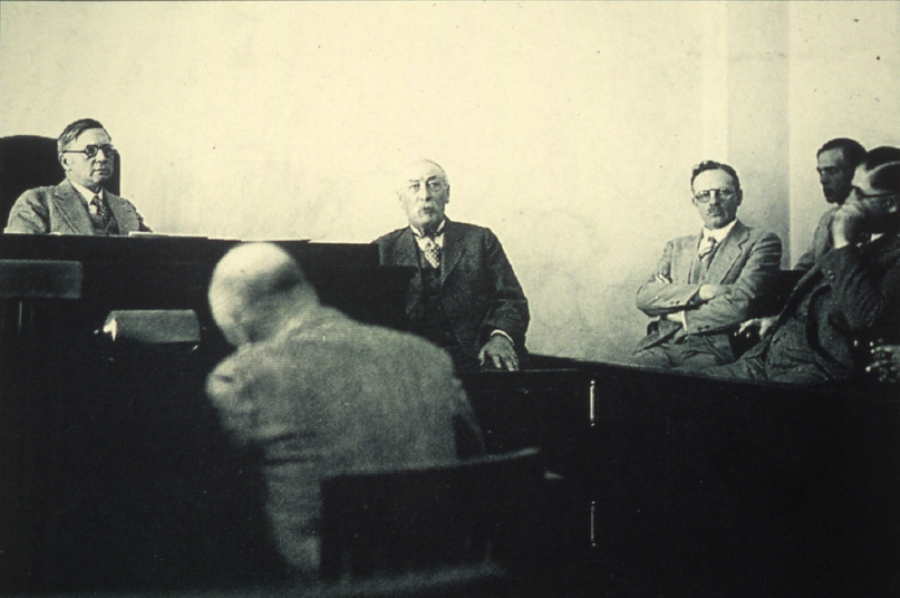
Overall, though, the St. Francis Dam forensic investigations were relatively robust, earnest affairs. The experts’ findings have since been debated and at times corrected, but their assessments were relatively well-developed, if not yet geotechnically quantitative, reflecting the state of civil engineering at the time. The investigations treated William Mulholland gently but made clear that no future dam engineer could operate so independently. Mulholland’s own performance during the investigations was checkered. He famously took responsibility for the breach before a coroner’s jury, stating, “If there [was] any error in human judgment, I was the human. I won’t try to fasten it on anyone else.” Mulholland added that “The only ones I envy about this thing are the ones who are dead.” Elsewhere in his testimony, though, he deflected responsibility for the disaster onto a “hoodoo” – an evil spirit – at the site. Following the investigations, Mulholland was ushered into retirement, stepping down as head of the Los Angeles Bureau of Water Works and Supply and ending his 50-year career in water engineering. He died in 1935, shattered by the tragedy [2].
The St. Francis tragedy also got the wheels of government and professional regulation turning. In 1929, California tightened its laws to require that all dams be built under a licensed engineer’s supervision. Simultaneously, civic leaders in Los Angeles had the dam’s surviving central section dynamited to help put the disaster behind them. Meanwhile, the St. Francis breach added urgency to efforts by French engineers to form a global group for promoting dam safety. In the summer of 1928, delegates from six countries founded the International Commission on Large Dams (ICOLD) to help establish uniform, rigorous technical standards for dam design. The group’s efforts have significantly improved the safety of the world’s dams over the past century [1, 2, 4].
The St. Francis Dam story has been of intense historical and dam engineering interest ever since it occurred. Numerous studies by both civil engineers and historians have revisited both the technical and human aspects of the tragedy. Broader public interest in the failure also remains strong. In 2019, President Trump signed the St. Francis Dam National Memorial into law on the disaster’s 91st anniversary, and fundraising to build a visitors’ facility at the site is ongoing. The dam’s crumbling remnants remain there as a stark reminder of the paramount importance of properly designing and constructing dams using external reviews and per the contemporary standard of care [2, 4, 5].
References
(2) Hundley, N. & Jackson, D.C. (2015). Heavy ground: William Mulholland and the St. Francis Dam disaster. University of California Press.
(3) Paul, C.H. (1923). “Section 6: Foundations requiring special consideration – Dam foundations.” In G.A. Hool & W.S. Kinne (Eds.), Foundations, Abutments and Footings (pp. 280-293). McGraw-Hill.
(5) St. Francis Dam National Memorial Foundation. (2021). Latest news.
(7) Outland, C.F. (1963, Revised 1977). Man-made disaster: The story of St. Francis Dam. Arthur H. Clark Co.
This case study summary was peer-reviewed by Bill Johnstone, Ph.D., P.E. (Spatial Vision Consulting Ltd.) and Seth Thompson, P.E. (GFT).






Lessons Learned
Concrete gravity dams should be evaluated to accommodate full uplift.
Learn more
Dam failure sites offer an important opportunity for education and memorialization.
Learn more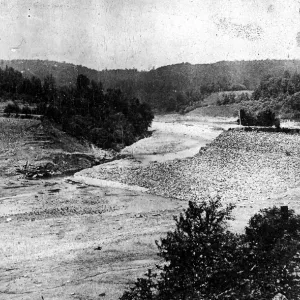
Dam incidents and failures can fundamentally be attributed to human factors.
Learn more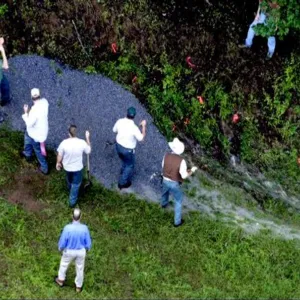
Intervention can stop or minimize consequences of a dam failure. Warning signs should not be ignored.
Learn more
Regular operation, maintenance, and inspection of dams is important to the early detection and prevention of dam failure.
Learn more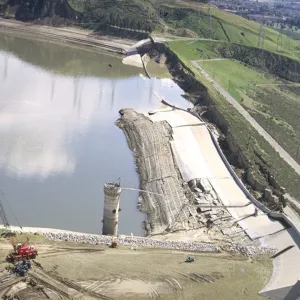
Stability of the dam foundation and other geologic features must be considered during dam design.
Learn more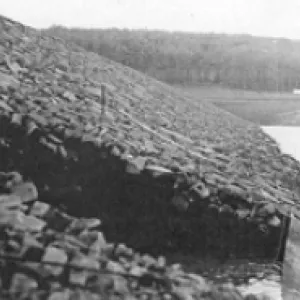
The first filling of a reservoir should be planned, controlled, and monitored.
Learn more
The Study of Past Dam Failures and Incidents is Essential for Keeping Today’s Dams Safe.
Learn more
The study of past incidents and failures aids in the assessment of existing dams.
Learn more
Timely warning and rapid public response are critical to saving lives during a dam emergency.
Learn moreAdditional Lessons Learned (Not Yet Developed)
- Safety should not be sacrificed for cost.

Human Factors in Dam Failures

Impacts of the 1928 St. Francis Dam Failure on Geology, Civil Engineering, and America

Lessons Learned from the St. Francis Dam Failure

Mapping the St. Francis Dam Outburst Flood with Geographic Information Systems
Reassessment of the St. Francis Dam Failure
The 1928 St. Francis Dam Failure and its Impacts on American Civil Engineering
The Limits of Professional Autonomy: William Mulholland and the St. Francis Dam

The St. Francis Dam Failure: Worst American Engineering Disaster of the 20th Century
St. Francis Dam Catastrophe – A Great Foundation Failure
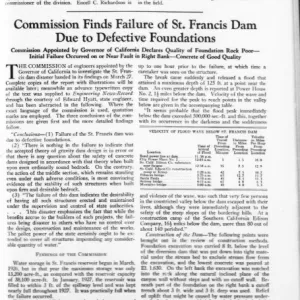
Commisson Finds Failure of St. Francis Dam Due to Defective Foundations
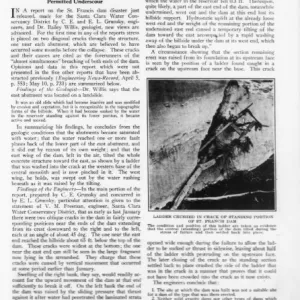
Sixth Report on St. Francis Dam Offers New Theories

A Man, A Dam and A Disaster: Mulholland and the St. Francis Dam
Additional Resources not Available for Download
- Nunis, Jr. & Doyce, B. (1995). The St. Francis Dam Disaster Revisited. Historical Society of Southern California and Ventura County Museum of History and Art.
- Nuss, L. K., & Hansen, K. D. (2013). Lessons Learned from Concrete Dam Failures Since St. Francis Dam. USSD Annual Conference Proceedings. United States Society on Dams.
- Outland, C.F. (2002). Man-Made Disaster: The Story of St. Francis Dam. The Ventura County Museum of History and Art. Ventura, California.
- VandenBerge, D. R., Duncan, J.M., & Brandon, T. (2011). Lessons Learned from Dam Failures. Virginia Polytechnic Institute and State University.
- Hundley, N. & Jackson, D.C. (2015). Heavy ground: William Mulholland and the St. Francis Dam disaster. University of California Press.
- Outland, C. (1977). Man-Made Disaster: The Story of St. Francis Dam. The Arthur H. Clark Co.